Teaching
The overarching goal of the qualification concept is to enable KD²School doctoral students to conduct independent and impactful research on the KD²School's focus topic of "Designing Biosignal-Adaptive Systems". To achieve this goal, we offer four different building blocks
- Specialist Knowledge
- Methodological Knowledge
- Interdisciplinary Skills & Networking
- Interdisciplinary Scientific Discourse
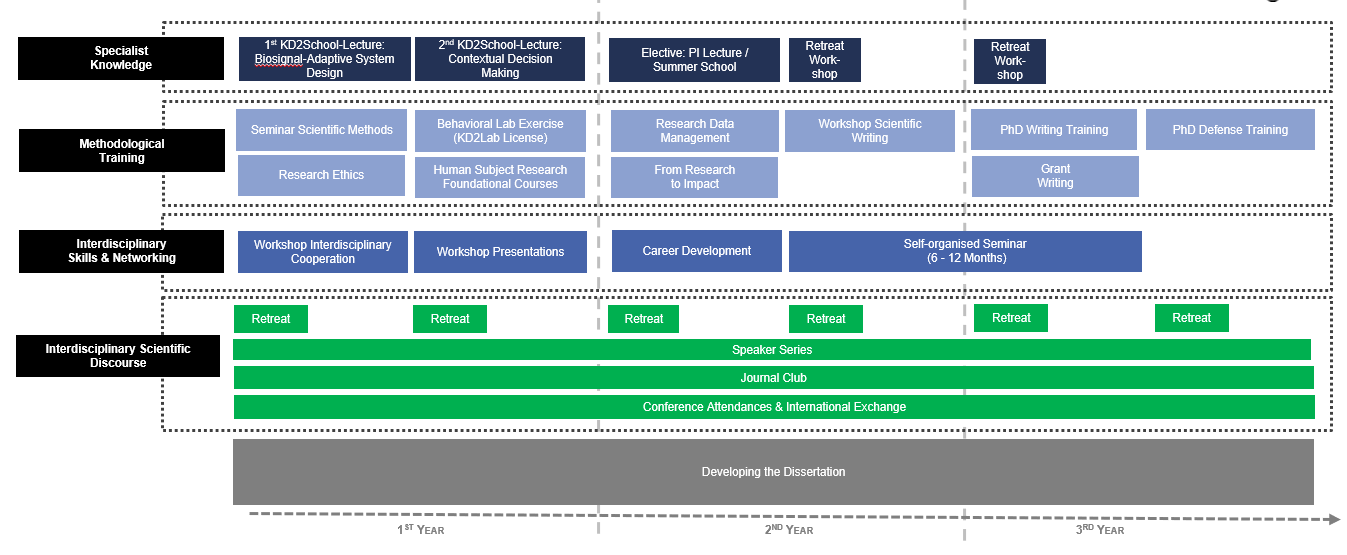
From a specialist knowledge point of view, we offer two dedicated lectures emphasizing understanding contextual decision making and designing biosignal-adaptive systems. Furthermore, PhD students have to attend one elective course of their choice offered by the PIs or attend a summer school. Furthermore, two specialst knowledge retreat workshops are offered (e.g. Machine Learning with Biosignals). From a methodological point of view, we provide foundations of scientific methods, research ethics, scientific writing and presentation as well as transferring the results to society. We tighty collaborate with organizations within KIT offering such courses, e.g. research ethics offered by KIT ARRTI. At the KD²School we put a strong emphasis on experimental research methods (e.g. Behavioral Lab Exercise in the KD²Lab) and foundations of human subject research and open science (offered by the KIT HSR Hub) and research data management (offered by KIT RDM).
We promote interdisciplinary skills and integration into academic and non-academic networks, which enables graduates to successfully organize research teams and implement research ideas. We offer formats such as workshops such as interdisciplinary cooperation (offered by KIT KHYS) or career development (offered by KIT PEBA). A specific format is the self-organized seminar, where teams collaborate and design, evaluate and publish a study on biosignal-adaptive systems. The interdisciplinary qualification at the interface between computer science, information systems, business & economics, and psychology & neuroscience is designed to prepare KD²School graduates for both the scientific and non-scientific job market. We promote interdisciplinary scientific discourse enabling integration and visibility of graduates through a wide range of networking activities with researchers and industry at home and abroad. This includes the retreat (twice a year), speaker series, a journal club, and conference attendences as well as international exchanges.
The overall qualification concept for the KD²School'is depicted here: