
Research Assets
A central goal of the KD²School is the development of research assets that enable and accelerate further research on biosignal-adaptive systems. Already within its first cohort, the school has produced a broad spectrum of such assets — ranging from open-source hardware and software tools to curated datasets. The resources below are openly available to the wider research community.
Hardware Assets
|
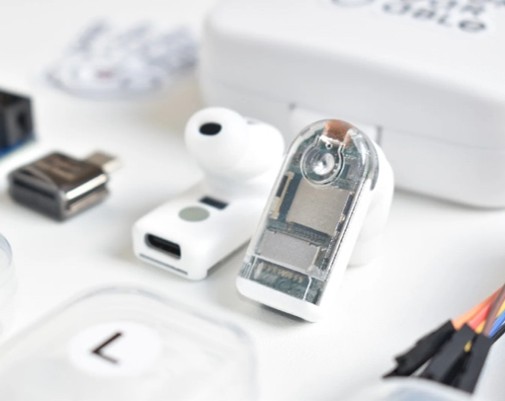
OpenEarable An open-source platform for ear-based sensing and application development. OpenEarable integrates a 9-axis inertial measurement unit (IMU), in-ear pressure and temperature sensors, inward- and outward-facing microphones, a speaker, a push button, and an RGB LED into a compact, modular earpiece built on the Arduino ecosystem. Website: https://open-earable.teco.edu/ Reference: https://dl.acm.org/doi/abs/10.1145/3712069 |
|
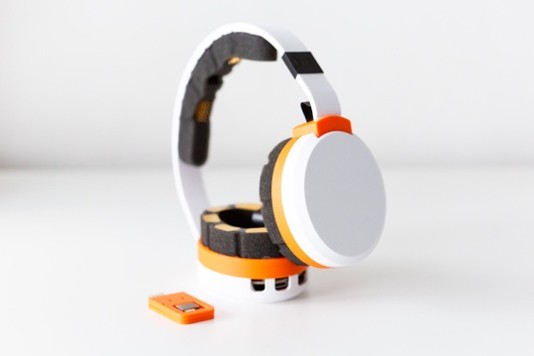
Open ExG Headphones Open-source headphones for electrophysiological recording. By combining the OpenBCI biosignal amplifiers with a low-cost, 3D-printed over-ear headphone design, the system records EEG, ECG, EOG, and EMG signals through dry electrodes at up to 21 configurable positions — enabling repeated, user-friendly measurements outside the laboratory. Website: https://github.com/MKnierim/openbci-headphones Reference: https://dl.acm.org/doi/full/10.1145/3544549.3585875 |

|
HUBII – Human Biosignal Intelligence Platform An open platform that makes biosignal processing accessible, transparent, and reusable. HUBII provides standardized, ready-to-use pipelines for processing, modelling, and consuming biosignals, organised along a biosignal taxonomy so that researchers can easily discover and apply them in line with the open-science paradigm. Platform: https://huggingface.co/hubii-world Reference: https://link.springer.com/chapter/10.1007/978-3-031-71385-9_18 |
|
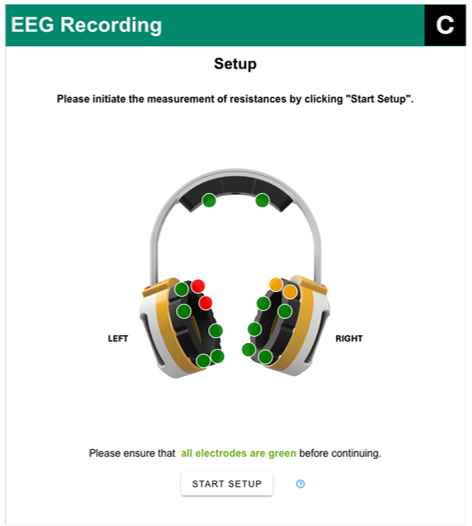
EEG-Collect (OpenBCI on the Web) An open-source web application for privacy-compliant EEG recording. Built around OpenBCI hardware, EEG-Collect streamlines the recording setup with real-time impedance checks and data visualisation, cross-platform compatibility, and efficient session management — making it well suited to large-scale and field studies. Code: https://github.com/OS-EEG-COLLECT/eeg-collect Reference: https://dl.acm.org/doi/abs/10.1145/3675094.3678482 |
|
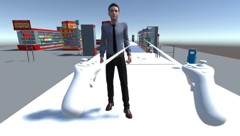
Open Pico4 VR Experiment Environment An open-source Unity framework for running experiments in virtual reality. Targeting the Pico 4 Enterprise headset, it ships with eye- and face-tracking examples and ready-made experiment templates, including immersive questionnaires, agent showrooms, a supermarket scene, and a Monty Hall decision task. |
|
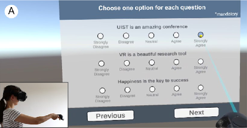
VRQuestionnaireToolkit An open-source Unity toolkit for collecting questionnaire data inside VR, AR, and MR. It integrates easily into existing projects and supports pre-, in-situ, and post-study questionnaires, allowing participants to respond without removing the headset. Code: https://github.com/MartinFk/VRQuestionnaireToolkit Reference: https://dl.acm.org/doi/abs/10.1145/3379350.3416188 |
|
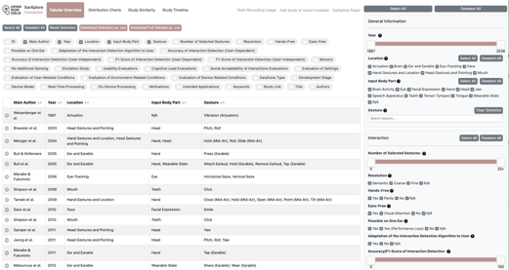
EarXplore An interactive, curated database consolidating research on interaction with earables — sensor-augmented earphones that enable new ways of sensing and control. EarXplore connects fragmented findings into a single accessible resource, supporting exploration, comparison, and discovery across this fast-growing field. Database: https://earxplore.teco.edu/ Reference: https://arxiv.org/abs/2507.20656 |
|
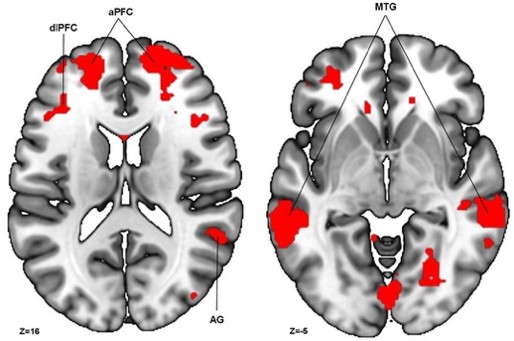
Food Decision-Making fMRI Dataset An fMRI dataset on food decision-making. Forty healthy participants rated food products for willingness to pay, perceived healthiness, and perceived tastiness while their neural responses to a front-of-package label were recorded. The dataset also includes the corresponding behavioural data and analysis scripts, all fully anonymised. Repository: https://osf.io/g86za/overview Reference: https://journals.plos.org/plosone/article?id=10.1371/journal.pone.0336356 |
|
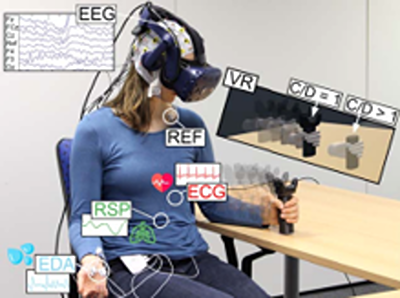
Hand Redirection in Virtual Reality (two datasets) Two HCI datasets on the detection of semantic body violations between a person’s real hand movements and those of their virtual avatar. (1) Noticeable hand redirection — examining extreme real-vs-avatar discrepancies; includes EEG, ECG, EDA, respiration, and hand-movement data. (2) Perceptual-boundary hand redirection — probing the perceptual threshold for redirection; includes EEG, eye-gaze, and hand-movement data. Dataset 1: https://ieeexplore.ieee.org/abstract/document/10108468/media Dataset 2: https://dl.acm.org/doi/abs/10.1145/3654777.3676425 |